
Canadian Patient Safety Week!
Every October, healthcare organizations across the country unite for Canadian Patient Safety Week. This national initiative is spearheaded by Healthcare Excellence Canada. Its purpose is straightforward yet vital.
To raise public and professional awareness about healthcare safety, spark open conversations about preventable harm, and continuously improve the quality of care delivered across Canadian hospitals, clinics, and community dispensaries.
For International Pharmacy Graduates transitioning into practice, whether stepping into the dispensary as a Licensed Pharmacy Intern or a Newly Licensed Pharmacist, this week holds deep significance.
When you have cleared your PEBC exams, you have earned your credential. But as you step behind the Canadian counter to manage actual prescriptions, you quickly realize that clinical knowledge is only half the equation. The other half is navigating the culture of safety within your dispensary.
So this year, we're exploring,
"What Shapes Safer Care?"
The Reality of Dispensary Errors
As a newly licensed intern or Pharmacist, you'll discover the cold, sudden wave of panic that strikes when a mistake is discovered in the dispensary.
And that mistake was made by YOU.
When you are navigating the high-stakes pressure of Canadian practice, balancing supervisory expectations, foreign-trained adjustment stress, and professional liability, an error can feel like a devastating personal failure.
In traditional practice environments, the immediate human response to a medication error is to:
assign personal blame,
feel deep shame, or
fix "near-misses" quietly to protect your reputation.
As Canadian Patient Safety Week begins, we must address a fundamental truth of Canadian practice:
Safety is not built on rigid perfectionism or fear. It is built on a "Just Culture."
What Is a "Just Culture"?
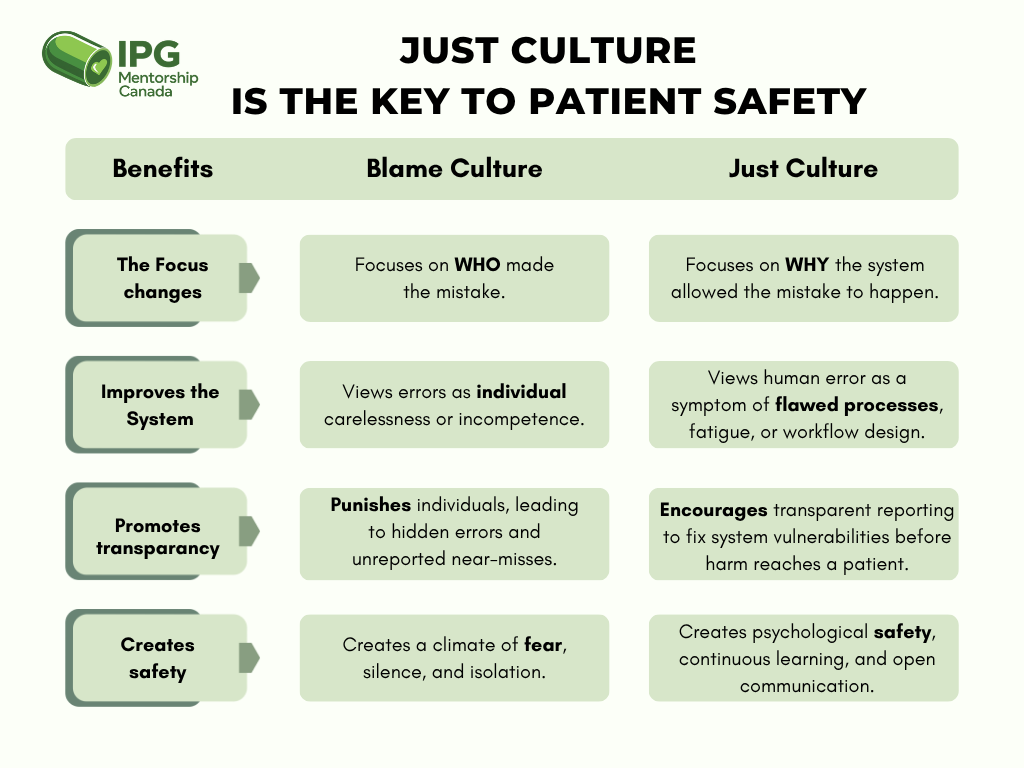
When a medication error or near-miss occurs in a busy dispensary, traditional workplaces often default to a Blame Culture.
Management asks:
"Who made this mistake, and who is going to take the blame?"
In a Blame Culture, errors are treated as individual failures of competence or care. This creates an environment of fear, shame, and silence, where healthcare workers fix near-misses quietly and conceal mistakes out of fear for their jobs, reputations, or licenses.
A Just Culture flips this model entirely.
Coined by safety experts in aviation and adopted across Canadian healthcare, a Just Culture recognizes that humans working in complex, fast-paced systems will inevitably experience slips. Instead of focusing on WHO made the mistake, a Just Culture asks WHY the system allowed the mistake to happen in the first place.
It creates an environment of psychological safety, encouraging healthcare professionals to report near-misses and errors openly, knowing...
...the focus will be on learning and fixing system flaws rather than pointing fingers.
Explore our PEBC Mentorship products
The Three Behaviors in a Just Culture
A Just Culture is not a "free pass" for poor practice. It clearly categorizes human actions into three distinct buckets:
Human Error (Inadvertent Slips)
A slip or lapse caused by human limitation (e.g., pulling Amlodipine 5mg instead of Amiloride 5mg off a shelf during a peak hour because the bottles look identical).
System Response: Console & Support. Fix the environment (e.g., add tall-man lettering, separate the bottles physically) and support the practitioner.
At-Risk Behavior (Taking Shortcuts)
Making a choice where the risk isn't fully recognized or seems justified to save time (e.g., bypassing an independent double-check process because the queue is growing).
System Response: Coach & Redesign. Help the practitioner recognize the hidden danger and remove incentives for taking shortcuts.
Reckless Behavior (Conscious Disregard)
Knowingly taking a substantial, unjustifiable risk (e.g., practicing while impaired or intentionally ignoring basic safety laws).
System Response: Disciplinary Action.
The Newcomer’s Dilemma: Overcoming the Fear of Reporting
For many foreign-trained interns and Pharmacists, admitting a mistake carries deep psychological anxiety.
In many international practice environments, a single error can mean job termination, public embarrassment, or loss of license. When you enter Canadian practice, that lingering trauma can tempt you to stay quiet when a near-miss happens.
You might catch a wrong dose during your final check as an intern and think:
"If I document this near-miss, will my supervising pharmacist think I’m incompetent?"
"Will this affect my sign-off hours or my standing with the provincial College?"
In Canada, provincial pharmacy regulatory authorities have established mandatory, anonymous incident-reporting programs (such as AIMS in Ontario or SafetyNET-Rx in Nova Scotia). These programs exist specifically because Canadian practice recognizes that unreported errors are disasters waiting to happen again.
When you report a near-miss through these frameworks, you aren't logging a personal flaw, you are contributing to province-wide data that helps manufacturers change look-alike packaging, alters provincial drug databases, and helps software vendors fix confusing screen layouts.
How to Practice Just Culture in Your Dispensary Daily
As a licensed intern or new Pharmacist, you can actively foster a Just Culture every day:
Reframe "Near-Misses" as Free Lessons: When an assistant, technician, or fellow intern catches an error before it reaches a patient, thank them. Reframe the event from "We almost messed up" to "Our safety checks worked exactly as intended."
Conduct Root-Cause Thinking: When a slip occurs, look beyond the individual. Ask: Was the lighting poor? Were two look-alike drugs placed side-by-side? Was the software alert overridden because of pop-up fatigue? Are the tall-man lettering labels missing?
Build Psychological Safety in Your Team: If a team member makes a mistake, do not react with frustration. Address the process constructively, focus on patient safety, and work together on a system fix.
Separate Integrity from Perfection: Professional excellence in Canadian pharmacy practice does not mean having a 0% human error rate in a high-volume dispensary. It means demonstrating 100% honesty, transparency, and commitment to system improvement when friction occurs.
Safety Starts with Openness
This Canadian Patient Safety Week, let us remember that safe patient care isn't built on rigid perfectionism or silence. It is built on open communication, continuous learning, and the courage to speak up.
When we replace blame with understanding, we protect our patients, empower our pharmacy teams, and uphold the true standard of Canadian healthcare.
Just Culture is the key to patient safety.
If this post resonated with you, please let me know. I want us to have a community together. Send me an email: [email protected]
Share your suggestions of topics you'd like discussed. This is our safe space.
Explore our PEBC Mentorship products
"Just Culture is the key to patient safety."