
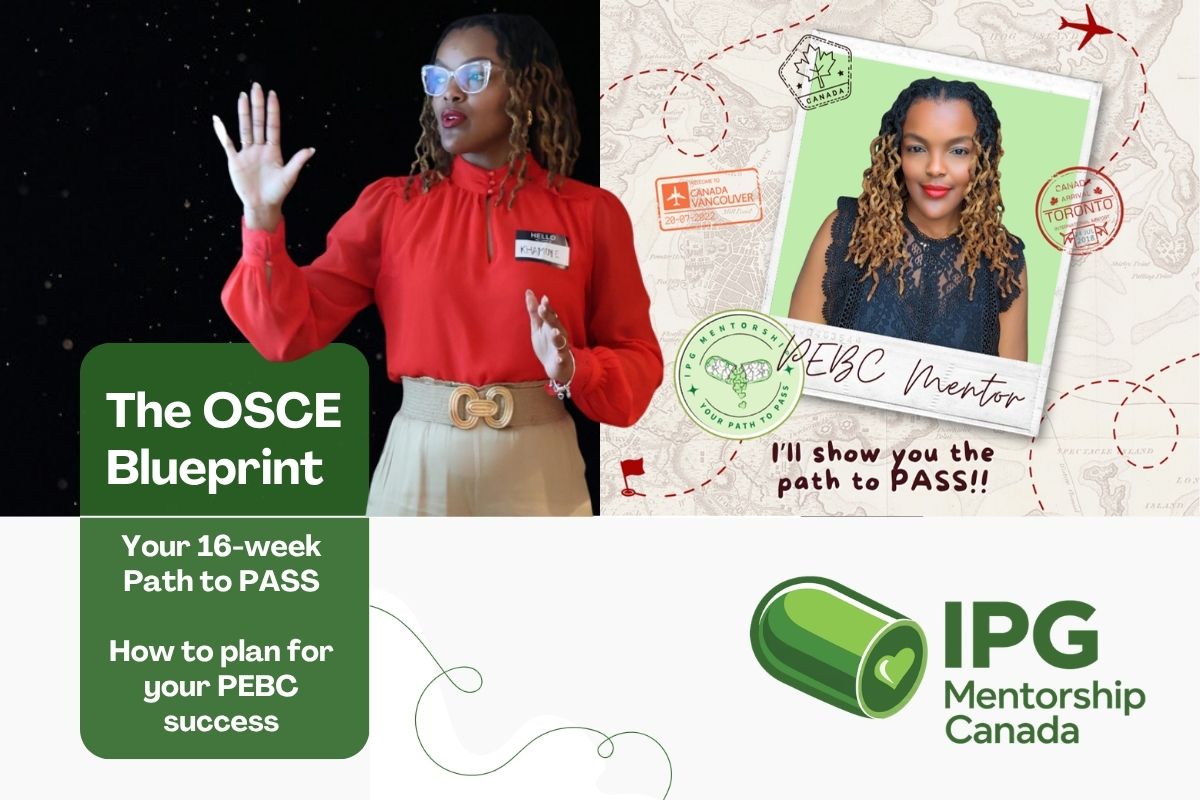
The OSCE Blueprint
If the MCQ tests your cognitive processing, the OSCE (Objective Structured Clinical Examination) tests your live, operational behavior under intense time pressure.
It doesn't matter if you are tackling this right after the written exam, stepping straight into Part II entirely on its own or doing it together with your MCQ, the moment you realize the OSCE is a performance-based, oral exam, a completely different type of panic sets in.
It is one thing to quietly select multiple-choice answers on a computer screen in a silent room. It is a completely different, soul-crushing wave of anxiety to stand in a hallway before a closed door, knowing that in 2-minutes, the buzzer will ring, and you have to walk in, look a human being in the eye, and think entirely on your feet.
And let’s be honest, if English isn't your first language, that fear multiplies by ten. The anxiety isn't just about whether you know the clinical guidelines. It’s about that terrifying mental lag of translating a therapeutic switch or an ethical resolution in your head while trying to speak confidently, match a patient’s emotional tone, and beat a ticking clock. Your heart is racing, your hands are sweating, and you feel completely exposed.
IPG Mentorship Canada guides our Mentees through a highly precise framework called the "OSCE Station in 7 Minutes." Our mentorship program does not view the OSCE as a frantic, seven-minute guessing game where you just rush through a script to beat the buzzer. That frantic energy is exactly what leads to failure. Instead, we train our Mentees to meticulously master and deconstruct each moving part of the station first before you ever try to look at a timer.
To make things even more interesting, PEBC has completely re-mapped the OSCE under the newly updated blueprint framework. If you want to survive the interactive rooms, you have to understand how the classic 9 NAPRA Competencies fit into the performance weights of this new layout. Let's break down the mechanics of the OSCE exam together so you can walk in feeling like the capable professional you already are.
The Baseline: The 9 NAPRA Competencies
Before we touch a single percentage on the new blueprint, we have to look at the foundation everything is built upon: the 9 NAPRA (National Association of Pharmacy Regulatory Authorities) Competencies.
Think of NAPRA as the operational standard for what a practicing pharmacist in Canada must be able to do safely on any given day. PEBC doesn’t write exam questions out of thin air; they map every single question directly back to these 9 core areas. If you understand what these competencies actually mean in real life, you stop studying like a student and start preparing like a clinician.
1. Ethical, Legal and Professional Responsibilities: This isn't just about memorizing the Controlled Drugs and Substances Act. It’s your operational guardrail. It tests your ability to handle real-world dilemmas, navigate provincial vs. federal law mismatches, manage professional boundaries, and maintain absolute accountability.
2. Patient Care: The crown jewel. This is the step-by-step cognitive process of being a clinician. It covers everything from gathering a history and interpreting lab values, to identifying Drug Therapy Problems (DTPs), designing a care plan, and monitoring therapeutic outcomes.
3. Product Distribution: The engine of the dispensary floor. This focuses on the technical and clinical accuracy of processing a prescription, assessing validity, calculating complex patient-specific doses, compounding, and managing the final technical check safely.
4. Practice Setting: This is all about dispensary logistics and operations. It tests your ability to optimize workflow safety, manage pharmacy inventory, handle drug recalls, and navigate the supply chain crisis during chronic drug shortages.
5. Health Promotion: Your role in public health. It focuses on disease prevention, engaging patients in wellness activities, and ensuring the safe handling and environmental disposal of hazardous materials.
6. Knowledge and Research Application: This is where evidence-informed decision-making lives. It tests your literature evaluation and biostatistics skills, forcing you to critically analyze a clinical trial or drug study to justify your therapeutic recommendations.
7. Communication and Education: You can have all the clinical knowledge in the world, but it means nothing if you can't communicate it. This tests your ability to deliver clear, safe, patient-centered education and establish consistent, error-free communication systems.
8. Intra- and Inter-Professional Collaboration: No pharmacist is an island. This measures how you work within a team, consult with other healthcare professionals, and safely manage referrals when a patient's needs fall outside your scope of practice.
9. Quality and Safety: The ultimate defense mechanism. This focuses on contributing to a culture of patient safety, handling medication incidents transparently, maintaining cold chain management, and reducing environmental contamination.
Reading this, you sound like a Pharmacist. Not someone preparing to just PASS an exam.
Your PEBC PASS was never about just an exam. It's your boarding pass to becoming THE most accessible health care professional in the world!

Connecting the Dots: The New Blueprint & Your Path to PASS!
Now that you know the 9 pillars, let’s look at how the newly streamlined PEBC blueprint packages them into high-stakes test categories, and exactly how you need to prepare for each one.
Domain 1: 1A. Providing Care: Clinical Care (40%)
The NAPRA Connection
This domain takes the heavy lifting of the original NAPRA Competency 2 (Patient Care) and anchors it as almost half of your exam. This is the absolute heart of your interactive stations. The exam is measuring how you structurally gather patient details, interpret diagnostic cues, and uncover Drug Therapy Problems (DTPs) out loud in real time.
How to Prepare for Success
In our 7-minute framework, this is where you Listen to the Opening Statement and Ask Relevant Questions. If a standardized patient (SP) presents a clinical complaint, you can't just blindly rattle off a generic checklist. For every question you vocalize, you must actively think: “How will this answer help me solve this case?” If you are focusing on a language barrier rather than the clinical clues, you miss the target. You are being graded on your clinical focus, not a rehearsed script.
Domain 2: 3. Communication and Collaboration (28%)
The NAPRA Connection
This section blends the original NAPRA Competency 7 (Communication and Education) and NAPRA Competency 8 (Intra- and Inter-Professional Collaboration). It tests how you communicate with an anxious patient vs. an interrupted healthcare worker (like a physician or nurse) to coordinate safe care.
How to Prepare for Success
This starts the second you step up to the door note. Step one of our framework is Reading the Door note to identify exactly who you are dealing with. Step two is executing a seamless, empathetic introduction: “Hi, my name is [Your Name] and I’m the Pharmacist. How can I help you today?” You must avoid medical jargon (as appropriate), practice active listening, and demonstrate how you collaborate within a multi-disciplinary circle of care.
Domain 3: 5, Professionalism (14%)
The NAPRA Connection
This pulls directly from the old NAPRA Competency 1 (Ethical, Legal and Professional Responsibilities) and NAPRA Competency 9 (Quality and Safety). It is the third largest weight on your performance exam. The examiners are testing how you react to ethical gray areas, legislative requirements, equity/diversity scenarios, and medication incidents under pressure.
How to Prepare for Success
When a standardized patient storms into your station angry about a dispensing error or an ethical boundary violation, this 14% tracks your response. You must employ best practices for disclosing medication incidents transparently, managing professional boundaries, and maintaining patient safety above all else.
Domain 4: 1B. Providing Care: Distribution (8%)
The NAPRA Connection
This covers the physical, practical execution of NAPRA Competency 3 (Product Distribution) and elements of NAPRA Competency 4 (Practice Setting). This is where technical check proficiency, device handling, safety practices, and your ability to process and release prescriptions accurately live.
How to Prepare for Success
When facing a distribution or device station, you must remain completely systematic. Our framework focuses heavily on knowing the exact layout of your clinical references. The size of the compendium should never intimidate you. You must be able to open a reference, flip directly to the required section, and swiftly verify a product’s therapeutic appropriateness, stability, or legal validity under intense time pressure.
Domain 5: 2. Knowledge and Expertise (7%)
The NAPRA Connection
This anchors NAPRA Competency 6 (Knowledge and Research Application), testing your ability to use professional judgment to make evidence-informed decisions in the best interests of the patient. The examiners are checking how you defend your clinical choices and rationalizations when challenged by a patient or another healthcare practitioner.
How to Prepare for Success
When you are asked why you are recommending a specific therapeutic alternative or clinical action, you cannot stumble or guess. You need to be able to state your clinical reasoning clearly and concisely, pulling from solid evidence rather than vague memory blocks.
Domain 6: 4. Leadership and Stewardship (3%)
The NAPRA Connection
This maps directly to the original NAPRA Competency 5 (Health Promotion). This tracks your ability to offer proactive, preventive healthcare guidance during your patient interactions.
How to Prepare for Success
This maps beautifully to the final steps of our 7-minute framework: Answer the question asked, Promote Health, and Monitor & Follow up. The OSCE rewards a pharmacist who takes appropriate action. You must deliver non-pharmacological health promotion tips, give clear timelines for improvement, and outline specific "red flag" outcomes that mean the patient needs to see their physician immediately.
This is exactly how IPG Mentorship Canada organizes our 16-week Mentorship plan.
Our Mentorship is actionable and intentionally aligned to PEBC's expectations, while providing you with the structure you need to stay consistent to your study goals. No more confusing, just pure strategy.
Enroll in our OSCE Mentorship

How to Create Your Study Plan
When you are trying to map out your week, preparing for the practical exam requires a completely different approach than a written test. You cannot just lock yourself in a room with your study notes and expect to PASS.
The OSCE requires movement, speech, and live execution.
To help you get organized, here is the exact operational framework I give my Mentees to build their weekly calendar:
Sunday is Plan Day: Map your study plan on Sundays and prepare for the next 7 days only. This process feels overwhelming when you try to see everything all at once.
Partner Practice: Find a dedicated practice partner. But remember the ultimate golden rule: Time management is not your core focus when you start. Instead, focus entirely on using the OSCE rubric to help guide you to complete the station successfully. Strategy first, speed second. Speed is a natural byproduct of a strong clinical strategy; trying to move fast without a plan just leads to chaotic errors on the floor.
The Weekly Structure: Dedicate at least 2 hours, 3 days weekly to your OSCE prep. This blocks out specific, non-negotiable times to get your head in the game, and yes, this absolute time allocation includes your live practice time with your partner.
The Content Connection: Logistically speaking, the OSCE is not as demanding as the MCQ when it comes to raw volume, however, you absolutely need to continuously review your MCQ therapeutic topics to confidently solve your OSCE cases. You cannot solve a clinical care or distribution problem out loud if you don't know the clinical foundation beneath it.
Accountability Check: Have at least one accountability partner. Use group time to peer-review tough concepts together. Group study sessions shouldn't be where you learn for the first time. Rather, where you clarify concepts and exchange knowledge.
I have a gift for you!!
The "OSCE Station in 7 Minutes" Framework
While I break this down to a microscopic level inside the Mentorship, I want to give you a quick high-level map of what the clinical lifecycle of a station actually looks like. This is how you orchestrate a room in real time:
Read the Door Note: Your door note is your very first clue of what your station is about and exactly who you are going to be speaking with (e.g., Patient vs. Healthcare Worker).
Introduce Yourself: Walk in, look them in the eye, and establish immediate professional control: “Hi, my name is [Your Name] and I'm the Pharmacist. How can I help you today?”
Listen to the Opening Statement: Practice intense active listening. This contains the exact question you are expected to answer. What did your Standardized Patient (SP) ask you? Write it down immediately so you don't lose it under pressure.
Ask Relevant Questions: While acronyms like SCHOLAR-HAMS are great, not every single question is needed in every single case. For each question you choose to vocalize, ask yourself: “How will the answer to this question help me solve this specific case?”
Check Your Reference: What question do you want to answer? Do you know the layout of a standard monograph? Go directly to that specific section of the reference. The physical size of the reference book or database should never intimidate you, be intentional when you check your reference.
Answer the Question Asked: Remember the exact question your SP asked you that you wrote down at the beginning? Answer it clearly now. Refer out to books only if you absolutely have to. The OSCE wants the Pharmacist to take confident, professional action.
Promote Health: Non-pharmacological interventions equal health promotion. What are some practical, non-drug lifestyle ways your patient can actively manage their condition?
Monitor & Follow Up: Establish safety nets. Within what specific timeframe will their condition improve or resolve? What specific negative outcomes mean treatment failure, requiring them to immediately see their doctor?
Get off the fence, be realistic about what you can achieve daily, and execute your plan with consistency. Build the schedule, practice the strategy, and take control of your path to licensing.
Enroll in our OSCE Mentorship
As your Canadian Pharmacist re-licensing concierge, you are in the best hands with IPG Mentorship Canada I'm not just showing you the Path to PASS (and you will PASS), I'm re-calibrating your mindset to thrive in Canada and thriving includes weathering your storms. Let's do this together!
I can't wait to talk with you again.
If this post resonated with you, please let me know. I want us to have a community together. Send me an email: [email protected]
Share your suggestions of topics you'd like discussed. This is our safe space.
Explore our PEBC Mentorship products
"Your Path to PASS!"