
"I didn't want to disappoint myself"
Recently, I was running a live 1-on-1 practice session with one of my mentees.
We were working through a set of 10 multi-layered pharmacology practice questions. The kind designed to test drug classes, contraindications, and subtle mechanism distinctions under high-stakes pressure.
When she read all 10 questions her initial reaction was completely honest: "I only know 3 of these answers."
If you’ve ever sat in front of a practice exam or a real PEBC paper, you know that exact feeling. It’s the instant pit in your stomach that tells you:
"I haven't studied enough. I'm not ready. I'm going to fail."
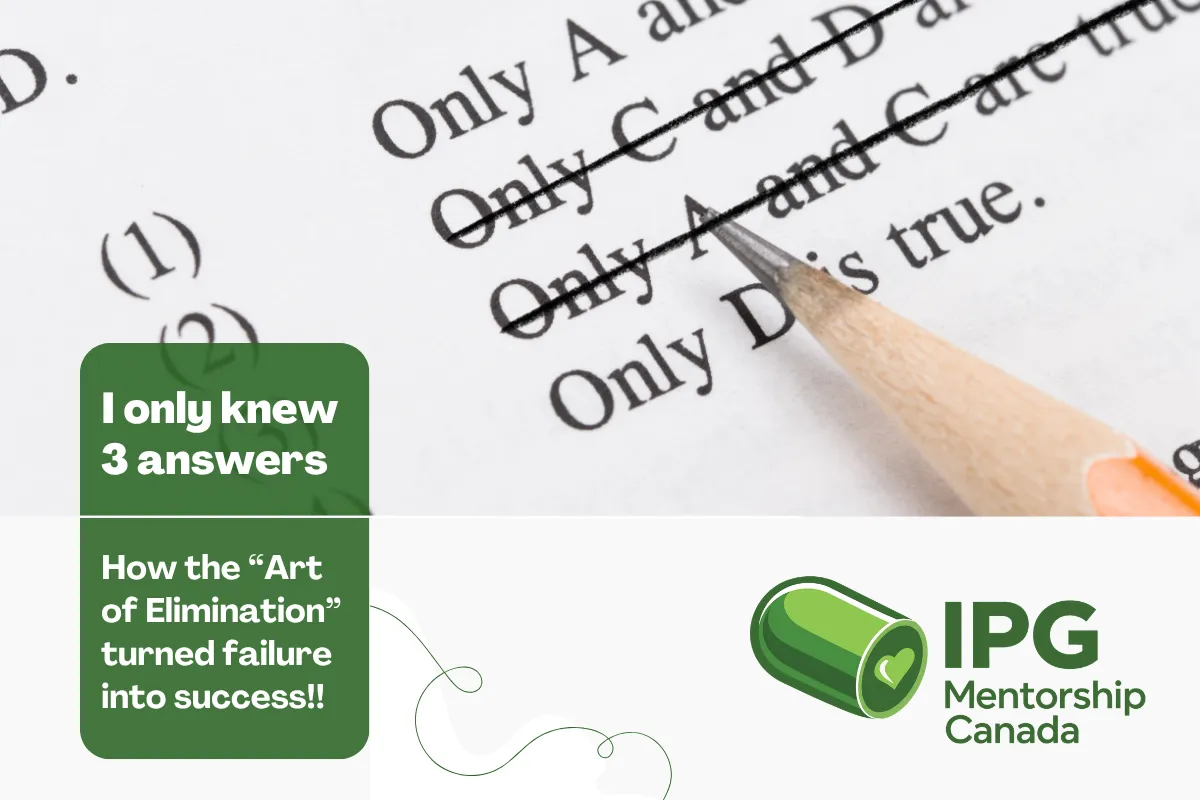
In the past, that feeling might have led to panic-guessing, speed-reading, or a total cognitive shutdown. But today, we didn't rush. I allowed her the necessary time and space to process each case without a clock ticking in her ear. We applied the exact method we hone in the Mentorship: The Art of Elimination.
Instead of hunting for a "magic answer" hidden in her immediate memory recall, she turned the exam back on itself. She categorized medication groups. She identified which drug options belonged to the same class and could be eliminated together. She used basic physiology to rule out impossible side effects. Step by step, sentence by sentence, she systematically dismantled the questions.
When we tallied up the final score? She got 8 out of 10 correct.
And the two she missed? She looked at them, shook her head, and said:
"Had I given myself just a little more time to process, I would have gotten those two, too."
I cannot even express in words HOW EXCITED THIS SESSION MADE ME!!!

The Hidden Shift: Locking In to Honour HER Work
When we finished the exercise, I asked her what was going through her mind as she spent those extra minutes reasoning through options she initially thought she didn't know.
She gave me an answer so powerful, that it stopped me in my tracks:
"I didn't want to disappoint myself."
That single sentence is a massive paradigm shift for IPGs.
When IPGs talk about fear, it is almost always external. IPGs carry an immense weight of wanting to satisfy everyone else:
They don't want to disappoint their spouses or children who have sacrificed for this Canadian move.
They don't want to disappoint their parents back home who expect them to be do well.
They don't want to disappoint their peers, their mentors, or their community.
Because we are constantly fighting to prove our worth in a new healthcare system, our focus gets pulled outward. We play "defense" against the fear of external shame.
But in that practice session, my Mentee didn't use elimination tactics to save face for an audience. She locked in on the strategy to honour HER OWN work.
She realized that guessing or giving up on a question after spending months sitting at a desk, reviewing guidelines, and sacrificing sleep wasn't just getting the question wrong, it was betraying the effort she had put in. She decided that she was worth the extra 60 seconds of clinical processing time. She refused to let self-doubt rob her of a correct answer she was fully capable of deducing.
When you shift from "I hope I don't embarrass myself to others" to "I respect my own preparation too much to surrender this question," your entire test-taking psychology transforms.
5 Critical Lessons for the New Month
As we step into a brand-new month of preparation, I want every IPG preparing for their PEBC exams to internalize these five game-changing lessons from this session's breakthrough:
1. You Know Far More Than Your Initial Recall Suggests
Knowing the exact answer outright on only 3 out of 10 questions didn't stop her from scoring an 80%. Your immediate memory recall is only the surface level of your brain's clinical library. Your clinical reasoning is far deeper. When a question looks unfamiliar, don't ask "Do I remember this exact fact?"
Ask: "What do I know about these options that allows me to eliminate the wrong choices?"
2. Elimination Is Strategy, Not Guessing
The PEBC is designed to create uncertainty and throw you off balance. Hunting for the "right answer" among four confusing options puts you on the defensive. The Art of Elimination puts you on the attack. Grouping medications by mechanism, spotting duplicate option types, and ruling out illogical side effects turns a high-stakes exam into a logical puzzle.
3. Rest Is an Essential Clinical Tool, Not a Reward
During our session, we talked about cognitive stamina and the physiological necessity of sleep. My mentee shared how she had spent hours struggling to grasp a complex topic while exhausted, only to take a 30-minute nap and suddenly see the concepts crystal clear.
Studying while sleep-deprived isn't dedication, it is cognitive self-sabotage. Sleep is when your brain consolidates clinical memory and repairs neural pathways. If you are burning the candle at both ends, your clinical reasoning slows down, your anxiety rises, and your ability to eliminate wrong options collapses. Rest is an active tool to aid your studying; use it intentionally.
4. Put Your Family DIRECTLY on Your Study Plan
One of the biggest sources of emotional drag for IPGs is feeling torn between their textbooks and their families. My mentee shared how challenging it can be to balance study obligations and her family needing her attention.
Instead of treating family time as something you "try to fit in" when you're done studying (which leads to constant guilt on both sides), put your family directly on your calendar. Block off exact hours for your spouse and your kids with the same non-negotiable respect you give a PEBC exam module. When family time is scheduled, you can be 100% present without exam guilt, and when study time starts, your family knows you are executing a clear, predictable routine.
5. Replace the Fear of Failure with Self-Respect
When you sit down to solve a practice case or write the official exam, stop thinking about the expectations of the world outside the room. Lock in to honour your sacrifices, your late nights, and your resilience. Give yourself permission to slow down, take a deep breath, and process the clinical logic.
Coming out of this session, my Mentee was super charged up seeing what she was actually capable of when she focused on what she knew, instead of panicking about what she didn't remember. When she used the Mentorship accountability tools strategically, she unlocked a new level of possibility for herself and the work she's putting in. Her final words:
"I'm going to go create my weekly Study Plan right now! I can do this!"
She's preparing to PASS! Are you??
Step Into This Month with Honour
To every IPG preparing for their upcoming evaluating or qualifying exams: You have worked too hard to let self-doubt rush your thinking.
You aren't just trying to pass a test, you are reclaiming your clinical authority in Canada. Every practice question you work through with patience and strategy is a brick in the foundation of your future practice.
Honour your work.
Rest your mind.
Schedule your family.
Trust your process.
Let's make this month our most strategic month yet. You've got this!!
As your Canadian Pharmacist re-licensing concierge, you are in the best hands with IPG Mentorship Canada I'm not just showing you the Path to PASS (and you will PASS), I'm re-calibrating your mindset to thrive in Canada. Let's do this together!
I can't wait to talk with you again.
If this post resonated with you, please let me know. I want us to have a community together. Send me an email: [email protected]
Share your suggestions of topics you'd like discussed. This is our safe space.
Explore our PEBC Mentorship products
"You can't disappoint yourself!"